PARK WATCH Article June 2026 |
Matt Ruchel, Executive Director, reflects on 12 years of Labor government and what it has meant for nature in Victoria
The next Victorian election is looming and Labor is seeking a historic fourth term in government. It’s already the longest-serving government in the state’s history. As the election approaches, we look back at what the past 12 years have meant for nature policy, and ask whether the promise of 2014 has survived into 2026.
Coalition set the scene
Labor had held power since 1999, but was pushed out when they were defeated by the Coalition in 2010. That election led to a one-seat majority for the Coalition in both houses. A result almost no one anticipated. For nature policy, the four years of the Baillieu/Napthine Government were a disaster.
High-profile arguments over the return of alpine cattle grazing and inappropriate development at Point Nepean National Park, combined with the gutting of native plant removal regulations, set a damaging precedent.
Labor returns: ambition in the first term
In opposition, led by Lisa Neville as Shadow Environment Minister, Labor had worked hard on nature issues. A day before the 2014 election, they released a substantial nature policy, Our Environment Our Future. Labor won that election and returned to power under Daniel Andrews.
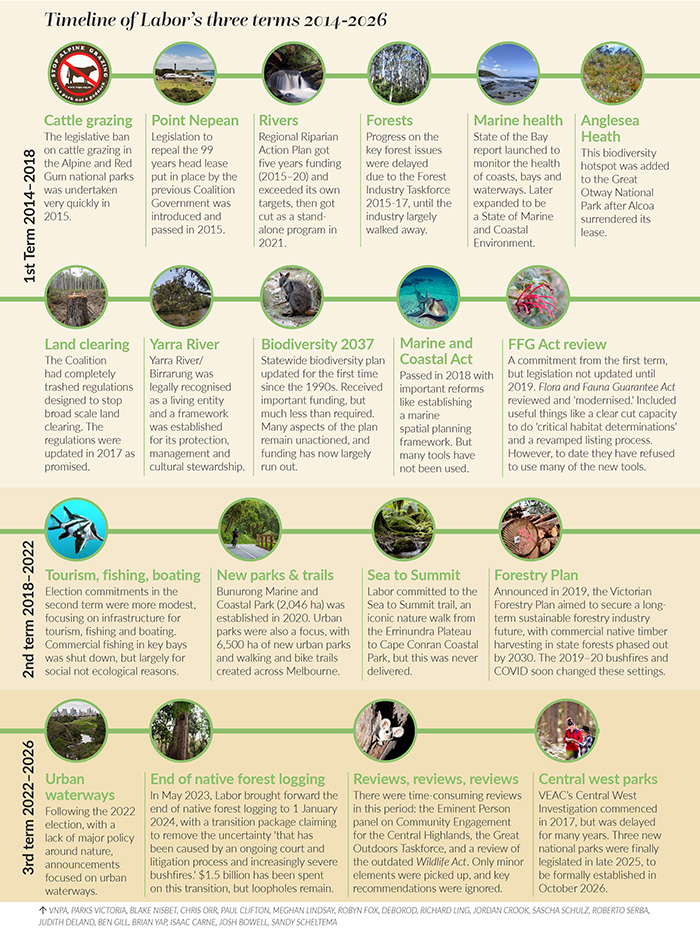
Andrews’ first term showed genuine ambition. In many ways it reversed the backward steps of the short-lived Coalition government. Across the first and second terms Labor introduced some important reforms. But they failed to sustain this ambition. In too many areas, interest simply faded. Meanwhile, the Coalition offered virtually no constructive nature policies of its own. The real policy contest was with the progressive minor parties, mainly the Greens.
Nature groups campaigned hard for a Great Forest National Park in the lead-up to the 2014 election. But it wasn’t reflected in formal policy. Instead, a Forest Industry Taskforce was created. The then environment minister was publicly quoted supporting the Great Forest National Park, but it never materialised into action.
In March 2017, Energy, Environment and Climate Change Minister Lily D’Ambrosio asked the Victorian Environment Assessment Council (VEAC) to begin the Central West Investigation – a significant step forward.
Though the process was delayed and interfered with multiple times, legislation was finally passed in late 2025, creating the first new national parks in 15 years. But it came with a sting. The Allan Government has since ruled out any new national parks.
The ‘Danslide’ and a retreat from nature
The cracks began to show after Labor’s first term. There was no standalone nature policy at either the 2018 or 2022 elections, with the focus shifting to recreation, fishing and urban parks. The majority from the 2018 ‘Danslide’ election seemed to reinforce an appetite for regressive positions, including refusing to create any new marine national parks or sanctuaries.
Progress on key forest issues was slowed by the Forest Industry Taskforce, which ran from 2014 to 2017, until the industry largely walked away. That process probably helped set the scene for the ultimate end of native forest logging. But the broader protection ambition, like declaring the Great Forest National Park, has effectively disappeared under Jacinta Allan. We’re now heading sharply backwards on some key issues.
End of native forest logging: a win undermined
On a positive note, the announcement of an end to native forest logging in May 2023 (which was implement in January 2024) was a huge milestone. But it came with a $1.5 billion transition package, with very little directed toward nature-based initiatives like helping forests recover.
In some ways the end to logging was only on paper. Key loopholes remain. Logging and logging-like activities continue on public land through the rebadging of many VicForests contractors as Forest Fire Management Victoria (FFMV) staff. And on private land. We’re seen a sharp increase in logging-like ‘fire preparation’ and so-called ‘storm clean-up’ works in the Yarra Ranges, Dandenong Ranges and Wombat-Lerderderg national parks.
The Eminent Person Panel and Great Outdoors Taskforce were poorly designed processes, and many of their useful recommendations for protecting nature were simply ignored.
In a big win for nature, the central west parks were eventually legislated in late 2025. But this was easily three to four years later than they should have been, and only after sustained pressure from full-page newspaper advertising and regional social media campaigns across Ballarat and Bendigo, year after year.
This big win was tainted with the devastating news that the Allan Government ruled out of any additional new national parks, ignoring recommendations from the Eminent Person Panel’s assessment of the Central Highlands.
Since Jacinta Allan became Premier, there’s been a marked shift. The government now appears almost openly hostile to nature, with numerous backward steps or dropped commitments. These include recently abolishing key expert bodies like the Victorian Environment Assessment Council and the Marine and Coastal Council, a shake-up of Parks Victoria with a new CEO and Chair, and staffing levels at their lowest since the 1990s.
What comes next?
Labor began with real ambition on nature policy in 2014, but since then that ambition has disappeared. The approach became patchy: some genuinely important decisions were made – the end of logging, the new central west parks – but these were undermined by backward steps and deals with certain sectors.
Today it looks like more than a mere lack of ambition. The Allan Government now appears openly hostile to nature.
All the indicators point in the same direction: nature in Victoria is in decline. And meaningful ambition from either of the major parties is seriously lacking.
By banding together, we can make it clear Victorians want nature on the priority list. With combined pressure, we can push back on backward steps and raise Labor and all major parties’ ambitions to look after nature in Victoria.
- Read the latest full edition of Park Watch magazine
- Subscribe to keep up-to-date about this and other nature issues in Victoria
- Become a member to receive Park Watch magazine in print