PARK WATCH Article March 2026 |
Jordan Crook, Parks and Nature Campaigner, unpacks a long-awaited review
When the Andrews Government ended native forest logging, they promised big additions to Victoria’s protected area network, particularly in the Central Highlands.
In late January 2026, the Victorian Environmental Assessment Council (VEAC) handed down its ‘Assessment of the values of state forests in the Central Highlands’. The report is based on findings from the Eminent Panel for Community Engagement (EPCE) released in October 2025.
However, the EPCE process has delivered protection for just 13,500 ha: the Yarra Tributaries Forest Reserve, which the government agreed to add to Yarra Ranges National Park. That reserve currently sits within a closed water catchment where public access is prohibited. This closed status will be retained. So realistically, this patch of forest was already a protected area.
Expert advice rejected
The Eminent Panel’s final recommendations included expanding the national parks estate to link many existing smaller parks, establishing significant areas as a forest park, which potentially permits forestry practices similar to those in the Otways Forest Park. It also recommended creating a new land tenure type, ‘cultural reserve’, featuring high levels of Traditional Owner management.
On the other hand, in its final assessment VEAC maintained that a large, expanded national park in the Central Highlands (unit areas 1 to 4 on the map) remains necessary, despite the government’s rejection. VEAC’s suggestion for ‘a large, protected area’ encompassing areas with outstanding natural values would have linked the existing national and state parks. It was not supported.
There’s strong community support for nature protection and expanded national parks. This disappointing outcome is a missed opportunity for the Allan Government to create the Great Forest National Park. A missed opportunity to give habitats and wildlife the chance to recover from decades of logging damage.
Hopes and threats
There’s still hope. While threats from logging (which could return with the stroke of a pen), mining and inappropriate development persist for these forests, so does the campaign to protect them through new and expanded national parks.
VEAC’s final assessment strengthens the case for expanded protection in the Central Highlands.
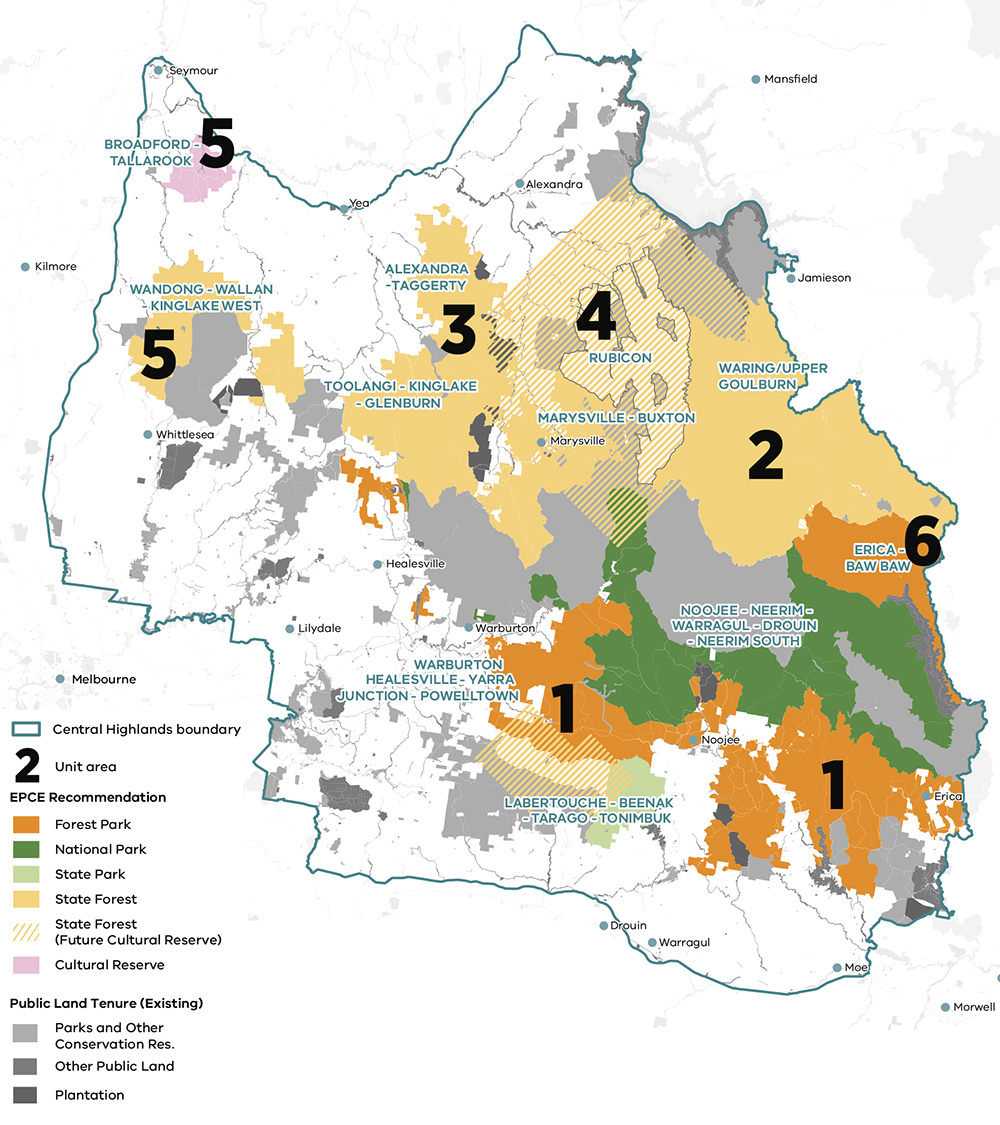
Units 1, 3 and 4
VEAC recommendation: Link Yarra Ranges, Kinglake, Lake Eildon and Baw Baw national parks and Bunyip, Cathedral Range and Moondarra state parks as an expanded national park.
EPCE proposal: Small additions to national parks, large areas to forest park, addition to Bunyip State Park. A cultural reserve above Bunyip State Park and the Rubicon area, with large areas to the north to remain state forests (unprotected).
Govt decision: Yarra Tributaries Forest Reserve added to Yarra Ranges National Park. Currently already protected in a closed water catchment where public access is not permitted.
Unit 2
VEAC recommendation: Could provide an opportunity to link the Yarra Ranges and Lake Eildon national parks. Has a high level of uses not generally compatible with national parks like hunting and minerals extraction. Forest park or regional park would be commensurate with the values and allow for these uses.
EPCE proposal: State forest.
Govt decision: No change.
Unit 5
VEAC recommendation: Several public land categories commensurate with the broadly lower natural values and uses that would conflict with protected area designations. More detailed information, including information from community engagement, is required for this unit.
EPCE proposal: Cultural reserve for Tallarook State Forest area. Rest to remain state forest.
Govt decision: No change.
Unit 6
VEAC recommendation: Area of outstanding natural values commensurate with a national park designation. Covers upper Thomson Catchment with crucial importance for water supply. Conflict with protected area status such as mineral extraction.
EPCE proposal: Forest park.
Govt decision: No change.
- Read the latest full edition of Park Watch magazine
- Subscribe to keep up-to-date about this and other nature issues in Victoria
- Become a member to receive Park Watch magazine in print